
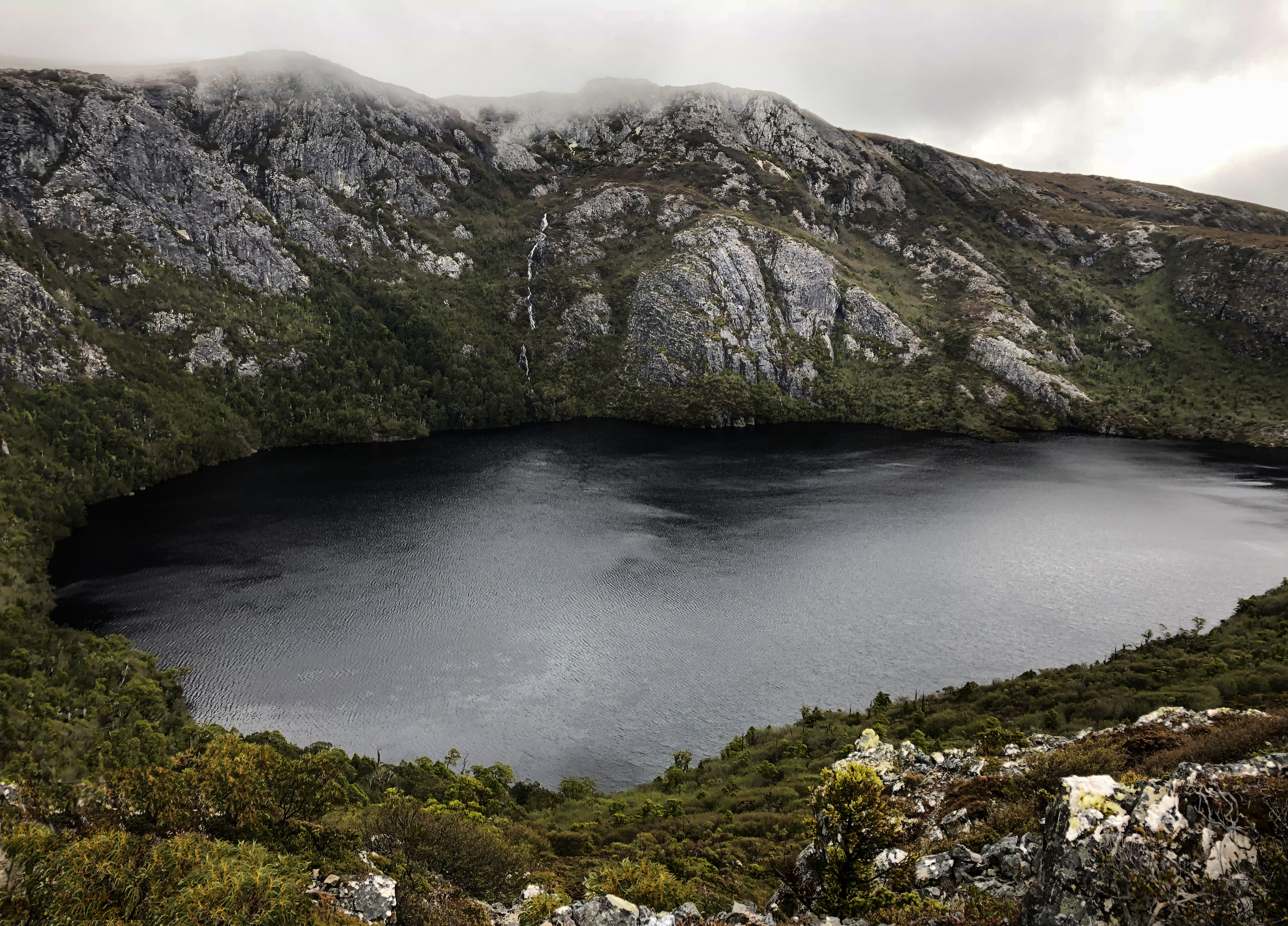
It`s afternoon – In the heart of the Tasmanian wilderness. I’m on a sixty-five km trail through the Cradle Mountain-Lake St Clair National Park. I take in the view: I am sitting in an elevated region – beneath me is a scene that demonstrates its beauty with modestly colours. The mountain lake, with its deep black colour it seems like all the surroundings get sucked into it. The only texture on the smooth water surface is the reflection of the surrounded summits, which lose their colour by mirroring in the lake and spawn even darker areas on the surface. The trees and bushes reach from the edge of the lake, even from inside the lake until the border where the mountains are not covered from vegetation anymore and disclose their real material. Huge rock faces disposed in an angle, which makes it look like one touch could make them go down into the lake. I feel like I do not belong here, my life in civilization has not equipped me for this journey.
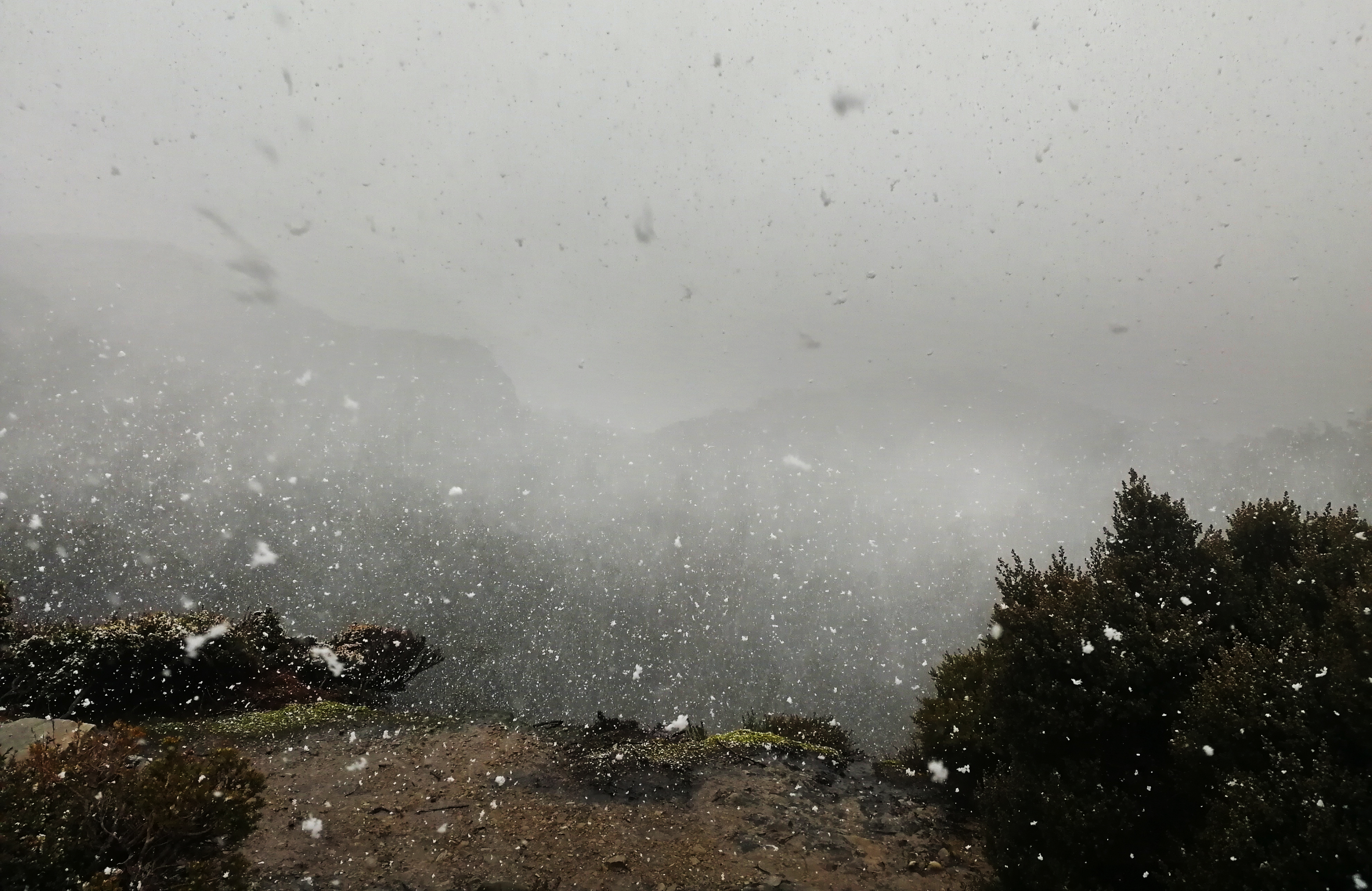
Dark clouds appear on the horizon. In just a few moments, they descend and I am in blizzard. My radius of vision is limited to my fingertips and suddenly it’s only me and a tense fog. The hail is coming directly against me. I feel the power of nature like needle prints in my face. Very carefully, step by step I make my way along the gnarled, muddy, often stony path, which is in sections, by name, not a path anymore.
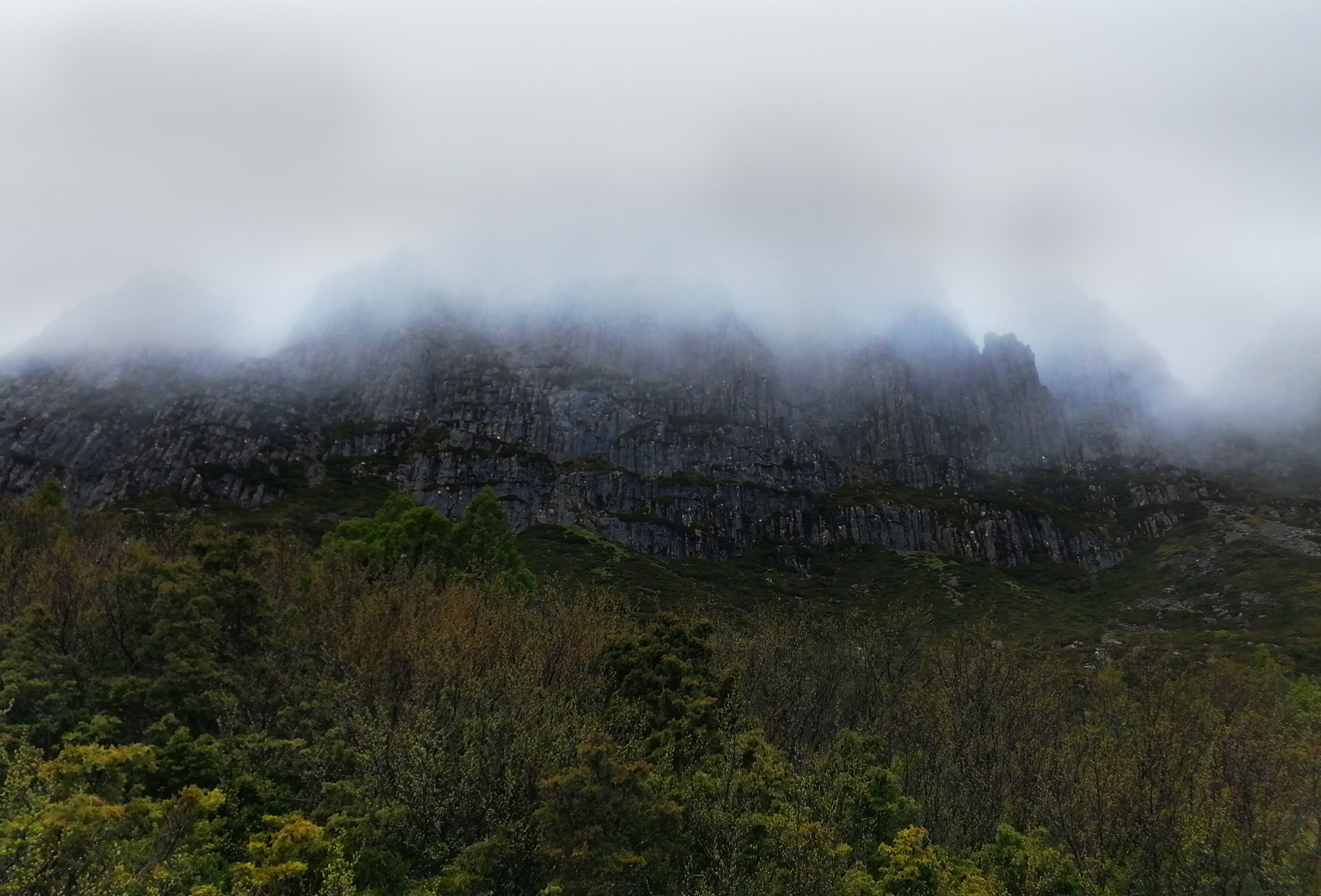
Suddenly, I see a cliff in front of me. One more step ahead and I would have fallen to my death. Standing still, I feel the wind coming from everywhere. Snow gets thrown in every direction; it seems like there was no gravity anymore. Particles where dancing, accompanied by the whine of the wind. I follow the uneven lines of the cliff. The view is limited, only the next comes through to your eyes, but is even so an incredible number of things. The trees shrouded by the fog, like powerful tribes the trees could be, they are standing there slim like a candle and are staggering in the strong wind. I set up my tent in the clearing of a forest. A Kangaroo is sitting beside the trees. A kitten heaves his head out of the bag of the mother. How cosy it must be, protected by mothers’ skin. I also crawled into my sleeping bag and tried to sleep.
Towards the end of the hike the wind stopped and there was silence. In the deep blue sky was no cloud to see, and the sun shone down. I bettered the blizzard. I felt weak, because I had no proper meal for five days. Time for the last recovery, sitting down for the last time in this nature, since kilometres of walking through this rough mountain path. My feet feel like I am still walking, every muscle every tendon give a signal of exhaustion. Again, I faithful realized the nature around me. How impressive and arousing it becomes, when you consider one thing in detail, is it the life of some animal species or is it only the mosses, which with their different flakes or the thinnest filaments cover the stones. It’s not only health-enhancing, but also calming, when you sit there and take in the impressions of the surrounding. The grassland beside the path with thousands of different flowers, the small rivers in between and the white stone where I am sitting at.
And when I move forward everything is changing slightly, but in some way still staying the same. And in everything sounds the uninterrupted noise of the wildlife. I felt like I was part of that. I felt like I belong here. Years after the hike, thinking about the magnificence about the Tasmanian nature, still brings a smile into my face. While living a life throughout the everyday norm of society, this hike allowed me to detach for a moment. The journey became a form of simultaneous self-improvement and meditation as I pushed myself to the limits. During this hike I felt like I was part of the surrounding nature like never before.
This blog shows the best spots in the Zillertal ( Ziller Valley) in Austria, to have an incredible adventure.
Valleys are created by running rivers and shifting glaciers. The massive blocks of snow and ice slowly creep downhill where they will meet the least resistance: valleys already cut by rivers and streams. As the glaciers ooze, they pick up rocks and grind away at the valley floor and sides. It seems like the Zillertal (Ziller Valley) was created thousands of years ago, just to become this perfect area for holidays. Surrounded by numerous three-thousand metre peaks and the impressive mountain world offers a diverse Opportunities for all kind of alpine activities.
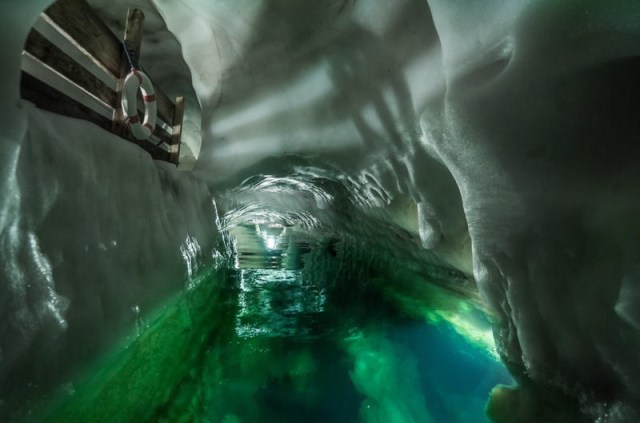
You can not imagine? Who payed attention in the chemistry lessons knows that water freezes by 0 degree. How is it possible, that in an ice cave, where there is permanently minus degree, a sea is surrounded by ice. The University of Innsbruck is still researching this phenomenon. Now you want to know where this Ice Cave is. The since 2010 known cave is on an altitude of 3250m under the Hintertuxer Gletscher (Hintertuxer Glacier). The Ice Cave has a constant temperature of 0°C 365 days a year. For the tour therefore clothes and good shoes are needed. With its cool natural beauty, the cave fascinates adult glacier fans as well as families with children over 6 years. So far the eyes can see in the cave, there are everywhere Irregularities, humps and indentations, but everything is still very smooth. All over is freezing mass, walls of ice, shattered, rugged and contoured by countless blue curved lines. All this scenery is shining due to the different light reflections. It’s a subterranean world consisting from ice and light.
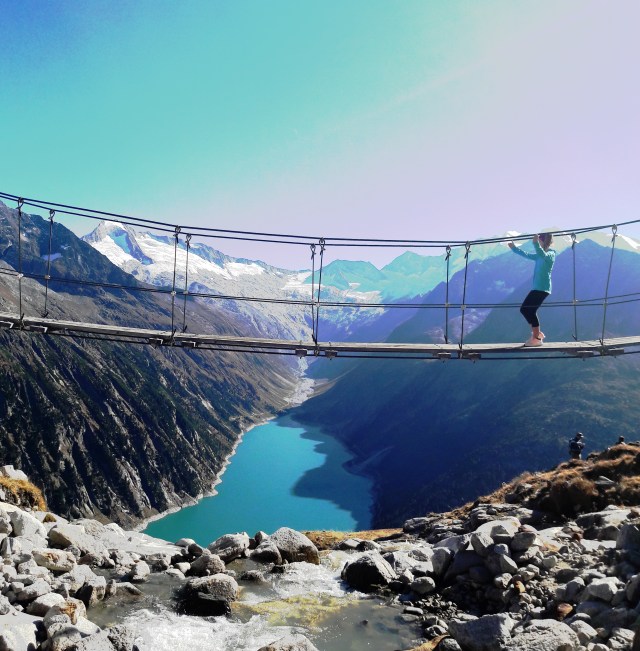
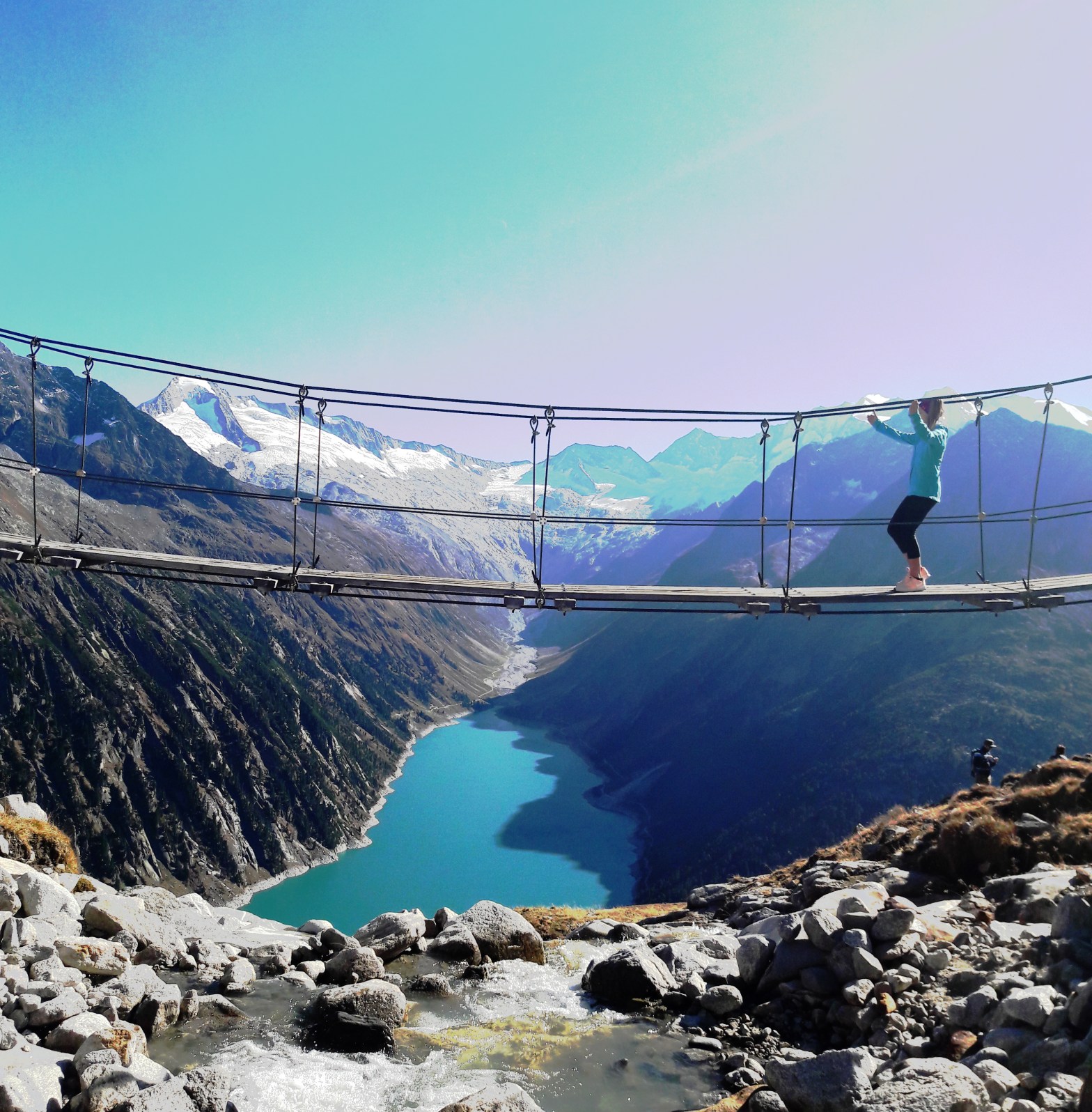
This suspension bridge is part of the Berliner Höhenweg. It’s a mountain hike which is not only a scenic Highlight, also the History and the heritage-protected Berliner Hütte ( Berliner Cottage) make this high altitude trail unique. The good thing is, the Length and the start of the hike can be chosen individually. Therefore, it is also suitable for less experienced hiker or for walkers, who do not want to undertake an exhausting trip. The gently curved path leads you through grassy meadow, roaring creeks and water falls up to the top, from where you can enjoy a breath-taking view across the Alps. It is for people who are seeking peace and calm.
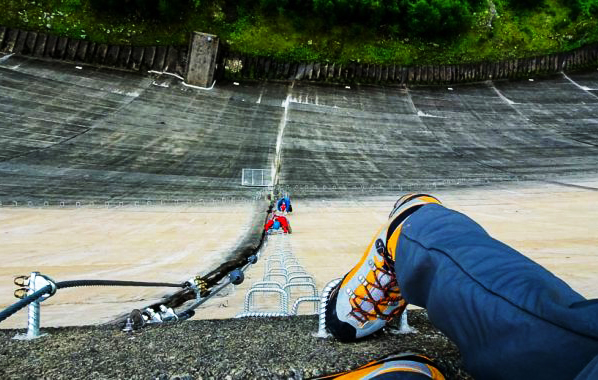
The dam of the in 1967 built Schlegeis-Speicher (Schlegeis Dam) is impressive: when you stand on the bottom of the wall you become aware of the colossal dimensions of this barrier. 131 meters high, the upper part bulges outwards. Due to the overhang of the wall the upper part Is protected from the rain, his makes the dam two-coloured, in the lower area dark grey, towards the top beige. Thinking about climbing this wall is terrifying but at the same time tempting. There is a fixed rope route which leads straight ahead to the top of the wall. All you need is the climbing equipment, which you can hire directly at the place, and a lot of courage.
Everyone can travel the world – it doesn’t matter what social status, family status or how big your bank account is – the only thing you must do is take your time and travel.
The author Rolf Potts hits the road permanently. He talks about his own references, by giving ideas how easy it is to do travel the world. The author presents his material in a clear and well-patterned way, offering not only insights from his many years of extended travel, but also plenty of online resources, profiles of great historical travellers, and insights from other Vagabonders. The book is not only about how to do travelling but also shows up different ideas how to think about life and work. Vagabonding is defined as the act of leaving behind the usual surroundings to travel independently for an extended time. The book describes how the modern world convinced us that long-term travel is only for the superrich, what is evident is that this is not the case. Long-term travel can be accessible affordable and realistic if you want it to be. Vagabonding is possible regardless of demographics, age, or income.
Rolf Potts, Vagabonding: “Long-term travel isn’t about being a college student; it’s about being a student of daily life. Long-term travel isn’t an act of rebellion against society; it’s an act of common sense within society. Long-term travel doesn’t require a massive “bundle of cash”; it requires only that we walk through the world in a more deliberate way.”
Many people are stuck in their daily routines, it’s hard to get the free time and money to travel. The idea of leaving behind all your belongings and travel the world is tempting. The wish to carry out this dream, is often destroyed by the lack of certainty. The mental issues you are facing are clear. At first you must change the way you think about money and belongings. This mind change is not achievable during your trip, you must adopt this lifestyle long before you hit the airport. A minimalistic way of travelling makes it possible to get to many countries with a manageable amount of money.
When you loosen your grip on the certainties of life, vagabonding is easier than you think. By neglecting the tour guides and charter buses, you’ll need to interact with strangers and locals. You will arrange your own transportation, order your own food, carry your own bags, and start your own trip. While you should try your best to be safe, it won’t be perfect. Occasionally, you will look foolish or be ripped-off. You should always remind yourself that this is a unique experience, and at least you’ll have a story to tell. Also, you need less planning than you think. In fact, you shouldn’t plan everything ahead of time. Make choices as you go. Travelling can be tremendously more valuable, it can literally change your perspective on how you see the world.
The practical travel routines are often tiring and sobering. The euphoric moments, as usual in life, only occur at certain points. But what traveling does is to let you break through your daily habits. Force yourself outside of your daily schedule. It almost seems like one of the basic behaviour patterns that somebody might need to break is that of overthinking what it is going to be like. Open yourself up to the idea that it may not be as uncomfortable or being around people you don’t know is going to be an enjoyable experience. It’s not going to be uncomfortable, but even just slightly changing your idea of what comfort means. This will help you to strip away all the rituals, routines, and possessions you’ve accumulated. You are simpler than you think.
Travelling is a way of learning. You will meet different languages, cultures, landscapes and life circumstances. The most valuable part of travelling is to take all this impression and learn from them. Be curious and take time to learn about worlds outside. This book is for the 18 year old, who wonders how to fill the gap time she has between high school and college, the 45 year old freelancer, who’s not bound to any location for his work, but still doesn’t travel, for those who might be hesitant about trying a digital nomad lifestyle and anyone who’s never been away from home for more than a week.

 Dominik Eberharter